Ontario Bigfoot's latest news
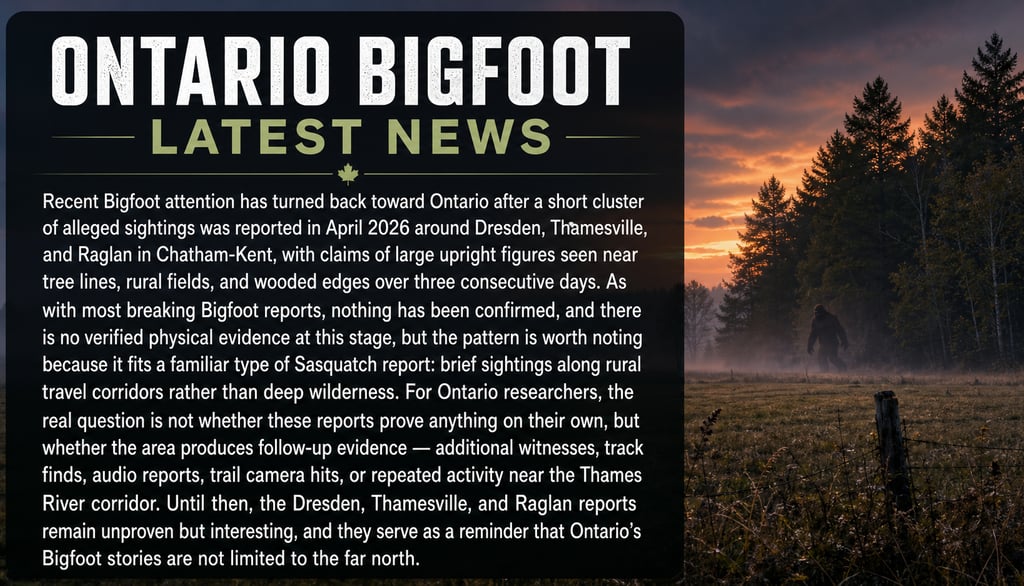
Recent Bigfoot attention has turned back toward Ontario ...
My post content
Ontario’s 2026 Bigfoot Reports: Dresden, Thamesville, Raglan, and the Return of the Southern Ontario Sasquatch
For years, when people talked about Bigfoot in Ontario, their minds usually drifted north.
Algonquin. Temagami. Kenora. Thunder Bay. The lonely logging roads. The black spruce. The half-forgotten canoe routes. The kind of places where a person can stand in the bush and feel, very quickly, that the map is only telling part of the truth.
But in April 2026, the strange attention shifted south.
Not to deep wilderness. Not to an isolated lake north of Highway 17. Not to a trapline or a remote hunting camp.
This time, the reports came out of Chatham-Kent, around Dresden, Thamesville, and Raglan — farm country, river country, rural edge country. And that, to me, is what makes the story interesting.
According to reports circulating through the Bigfoot Mapping Project, Bigfoot Society, and several media outlets, three alleged sightings occurred over three consecutive days in early April 2026. The first was near Dresden on April 3. The second was near Thamesville on April 4. The third was near Raglan on April 5. Each involved a large upright figure seen near a tree line or wooded edge, with descriptions ranging from a seven-foot black figure to a larger cinnamon-coloured figure.
Now, let’s be careful.
These reports are not proof. They are not confirmation that a Sasquatch was moving through southwestern Ontario. They are not physical evidence sitting on a lab table.
But they are worth looking at.
Because whether one believes the witnesses saw a Bigfoot, misidentified an animal, encountered a person, or got caught up in something more ordinary, the pattern itself deserves attention. Three reports. Three days. Same general region. Similar descriptions. Rural corridors. Tree lines. Water nearby.
That is exactly the kind of situation serious researchers should document before the trail goes cold.
The Dresden Report
The first reported sighting came from the Dresden area on April 3, 2026, around 6:15 a.m. A commuter reportedly saw a large black bipedal figure standing near the edge of a tree line beside a field. Some summaries placed the estimated height around seven feet.
That detail — standing near the tree line — matters.
Many Ontario reports do not involve a creature standing in the middle of a road like some movie monster waiting for headlights. They happen at the edges. Field edges. Swamp edges. Hydro corridors. Cut lines. Lakeshores. The last few seconds before something steps back into cover.
This is one reason rural southern Ontario should not be dismissed too quickly. People hear “Chatham-Kent” and think agriculture, highways, towns, and open space. Fair enough. But that region also has river corridors, woodlots, drainage systems, lowland cover, and pockets of habitat that could allow animals — known animals, at least — to move through without being seen often.
Does that mean a Bigfoot was there?
No.
But it does mean the setting is not as ridiculous as some people might first assume.
The Thamesville Report
The second report came the next day, April 4, 2026, near Thamesville. This one is more detailed. The figure was described in some accounts as roughly eight feet tall, broad-shouldered, and covered in dark cinnamon-coloured hair or fur. Footprints and wood knocks were also mentioned in some versions of the report.
That combination — visual sighting, possible tracks, and knocking sounds — is the kind of thing researchers naturally pay attention to.
But it is also where caution has to come in.
Footprints need scale. They need clear photographs. They need measurements. They need a cast if possible. They need surrounding context — soil type, weather, direction of travel, stride length, human activity in the area, and whether the print shows pressure depth beyond what a normal person could make.
Wood knocks are even trickier. A knock in the woods may be interesting. A pattern of knocks may be more interesting. But wood knocks can come from people, branches, farm activity, construction sounds, hunters, or natural impacts.
That does not make them useless.
It means they need context.
And context is usually what disappears first.
The Raglan Report
The third report was near Raglan on April 5, 2026. In this case, accounts described a dog alerting before a seven-foot black figure was allegedly seen near a tree line. Wood knocks were also mentioned in some summaries.
Dog reactions are common in Bigfoot reports. Sometimes dogs bark aggressively. Sometimes they refuse to enter an area. Sometimes they cower. Sometimes they track something and then suddenly stop.
But again, a dog reacting is not proof of anything by itself. Dogs react to coyotes, deer, bears, raccoons, people, strange smells, and things we never notice.
Still, in a witness report, a dog reaction is worth documenting. Not because it proves the creature was real, but because it adds behaviour to the timeline. It tells us something unusual seemed to happen before or during the sighting.